
Explore airport passenger operations through an interactive simulation model based on Felipe Ángeles International Airport (AIFA).
The AIFA Airport Simulation Lab is an educational and analytical environment designed to help students, researchers and aviation professionals understand how passenger flows, processing capacity and airport resources interact within a terminal.
Users can explore the model, configure operational scenarios, run simulation experiments and analyse the resulting system performance directly from their web browser.
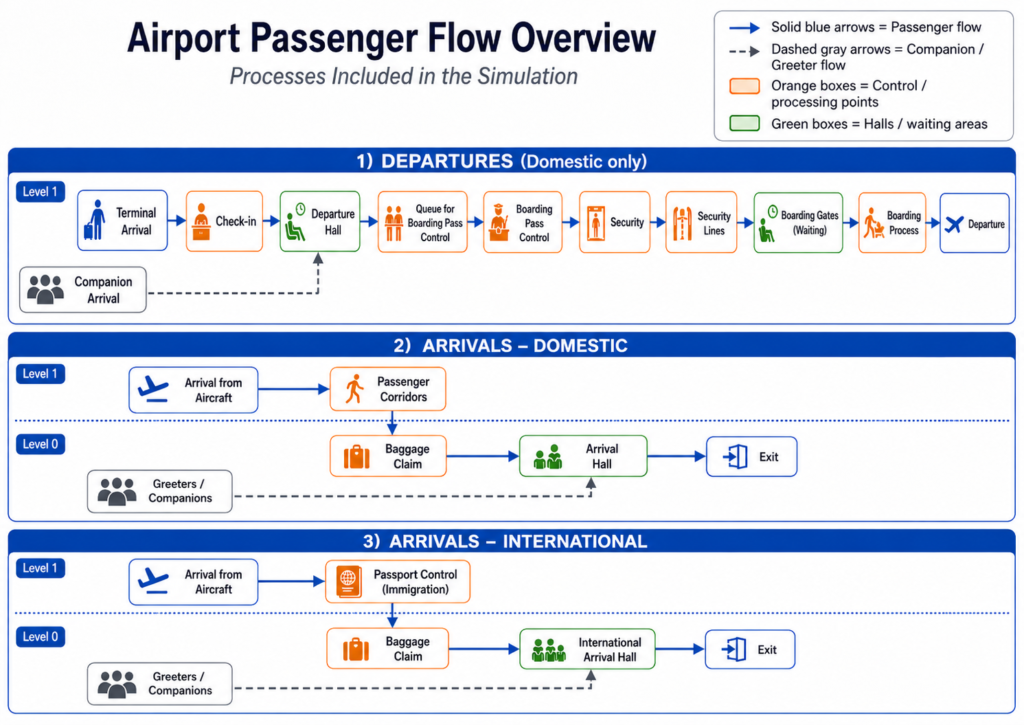
Before running an experiment, users are introduced to the structure and logic of the simulation through short explanatory videos and a passenger-flow diagram.
The model represents key passenger processes within the airport terminal and illustrates how different areas, resources and processing stages are interconnected.
The objective is to experiment with operational decisions and evaluate their consequences.
Change selected operational parameters to create different airport scenarios.
Depending on the experiment, parameters may represent aspects such as:
Each combination of parameters defines a simulation scenario that can be evaluated and compared with alternative configurations.
Once the scenario has been configured, the simulation is executed automatically through the platform.
No simulation software installation is required on the user’s computer.
The underlying simulation model remains protected while users interact with it through a controlled set of experimental parameters.
Simulation experiments allow users to investigate how operational changes affect total airport performance.
Depending on the scenario, results may include indicators such as:
Users can compare scenarios and identify how changes in demand, processing capacity or resources influence overall terminal operations.
Watch the introductory videos and review the passenger-flow diagram.
Enter or modify the available simulation parameters.
Submit the experiment and allow the platform to execute the simulation automatically.
Analyse the simulation outputs and evaluate the performance of the selected configuration.
Modify the parameters, run additional experiments and compare alternative operational strategies.
The AIFA Airport Simulation Lab provides a practical environment for introducing concepts related to:
By experimenting with different configurations, users can observe how local operational decisions may affect the performance of the airport system as a whole and the local impact.
The tool has been designed primarily for:
Students
Analyse airport infrastructure, capacity and operational performance through experimentation with a realistic airport case study.
Educators
Use the simulator as an interactive teaching resource for courses related to airport infrastructure, terminal planning, capacity analysis, simulation, airport operations and transportation systems.
Researchers
Explore infrastructure and operational scenarios, evaluate capacity constraints and demonstrate simulation-based analysis in an accessible web environment.
Aviation Professionals
Experiment with alternative infrastructure, resource and operational configurations to assess their potential effects on passenger flows, congestion, capacity and terminal performance, and to support the analysis of improvements in their own airport facilities.
The AIFA Airport Simulation Lab is an IGAMT simulation and educational initiative.
Web platform and simulation integration developed in collaboration with SCIAER Airport Engineering.
The AIFA Airport Simulation Lab is an independent educational and research tool. The simulation represents a modelled airport environment and should not be interpreted as an official operational representation, digital twin or forecasting system of Felipe Ángeles International Airport.
Simulation results depend on the assumptions, parameters and experimental conditions defined within the model and are intended primarily for educational, research and analytical purposes.